

Musk Thistle
Carduus nutans
Class C
Widespread in the state. Management decisions for these species should be determined at the local level, based on feasibility of control and level of infestation.
Children & Pets
This plant may pose a particular risk to unsupervised children and animals due to its toxicity or potential for injury.
Livestock Hazard
This plant presents a threat to the health and/or quality of livestock.
Local Ecosystems
This plant is detrimental to native ecosystems, negatively impacting the quality of forage for wildlife and reducing biodiversity in plant communities.
QUICK FACTS
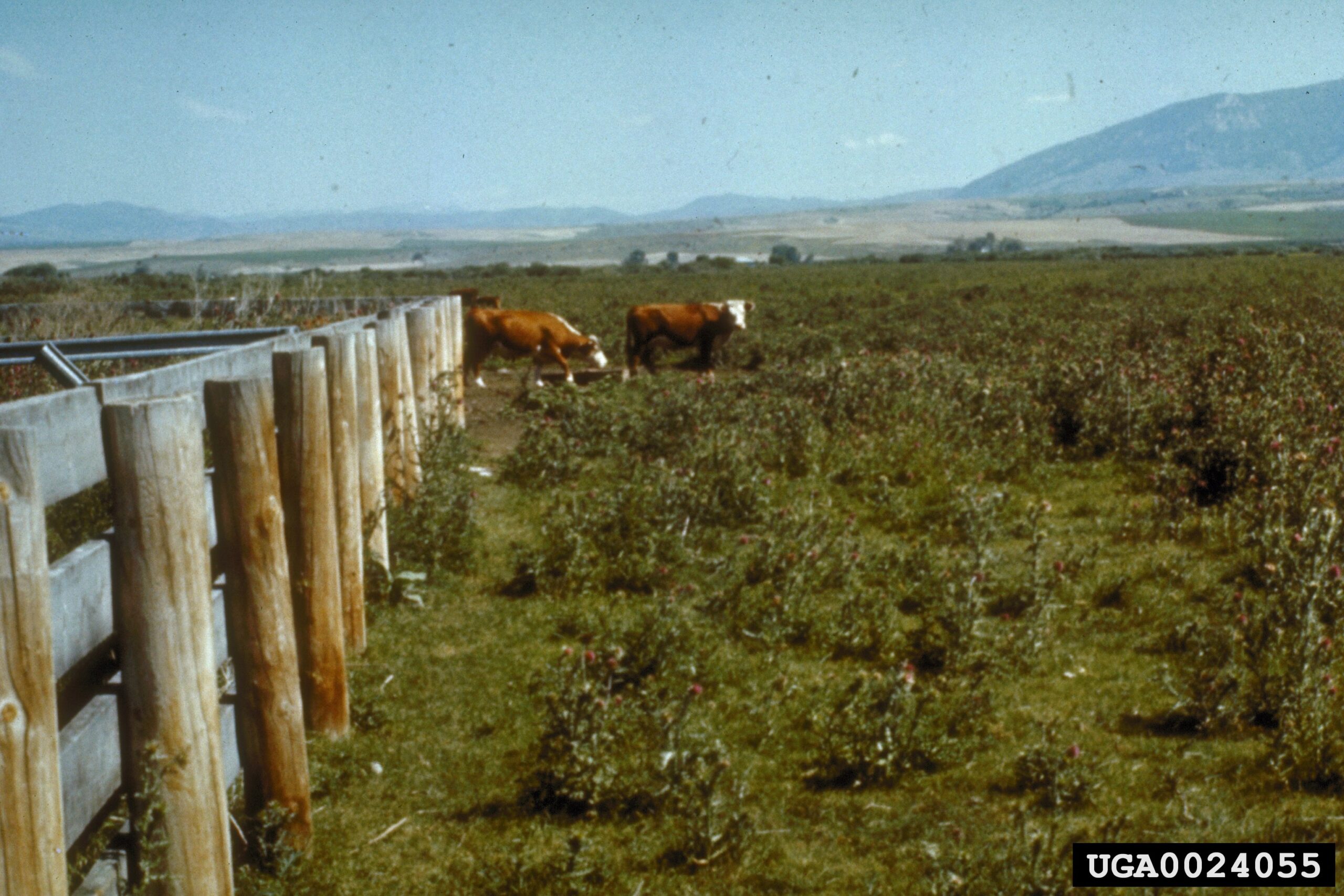
- Primarily an issue in overgrazed lands and disturbed soil. As the stem is too spiny for livestock to eat, they will consume the surrounding vegetation, further encouraging thistle growth and spread.
- The presence of one Musk Thistle promotes the germination of nearby seeds, rapidly creating localized outbreaks.
- Can produce between a few thousand and more than 100,00 seeds. Even though the seeds have a pappus (the white, fuzzy hairs that help the seeds become airborne), the vast majority of seeds will fall within 50 inches of the parent plant.
1. Overview
Musk thistle is an invasive weed with a flair for the dramatic, flaunting its purple blooms while quietly plotting a takeover of any disturbed pasture it can find. Beneath the showy exterior lies a highly competitive plant capable of producing thousands of seeds and crowding out native species with surprising efficiency.
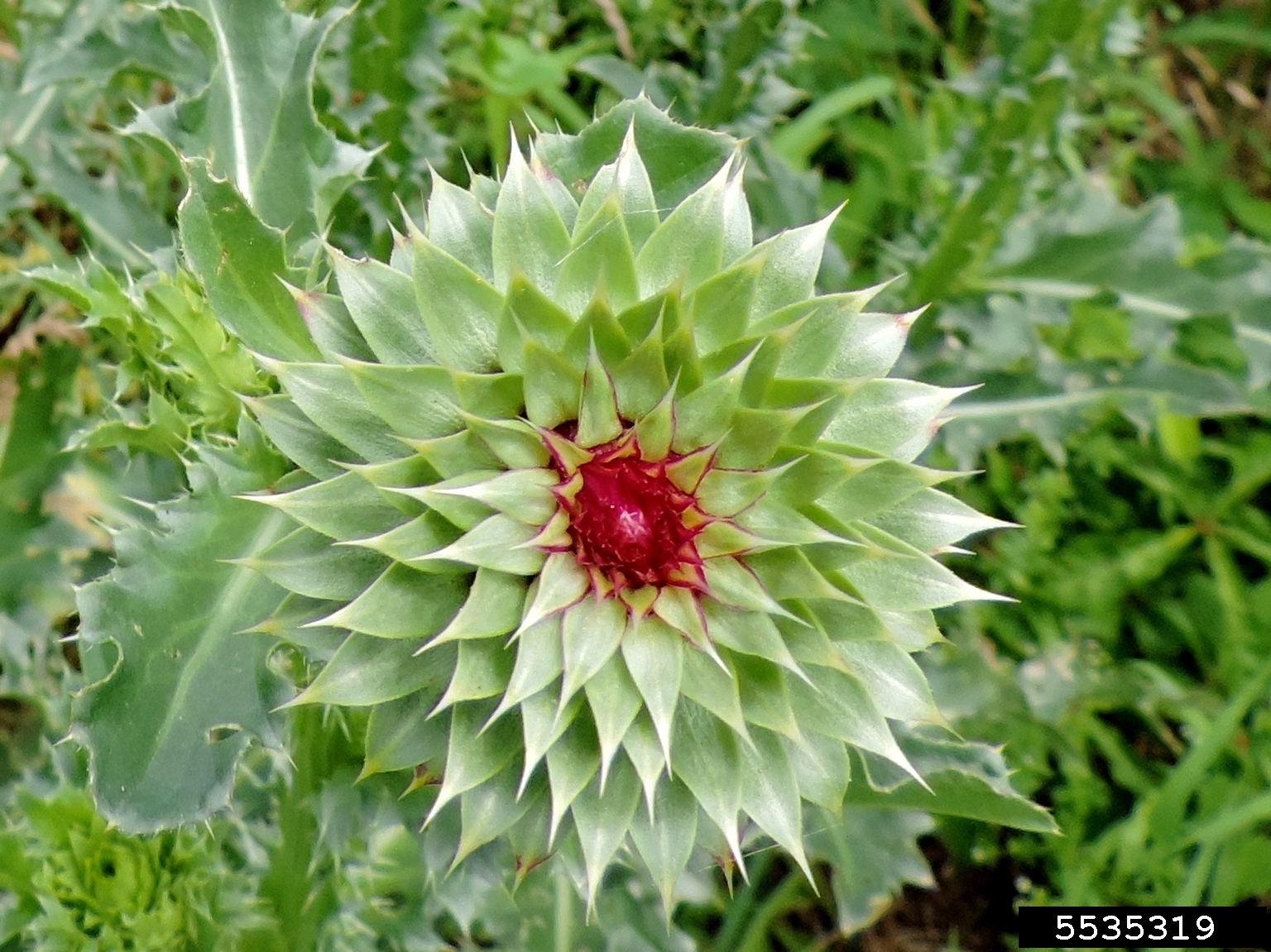
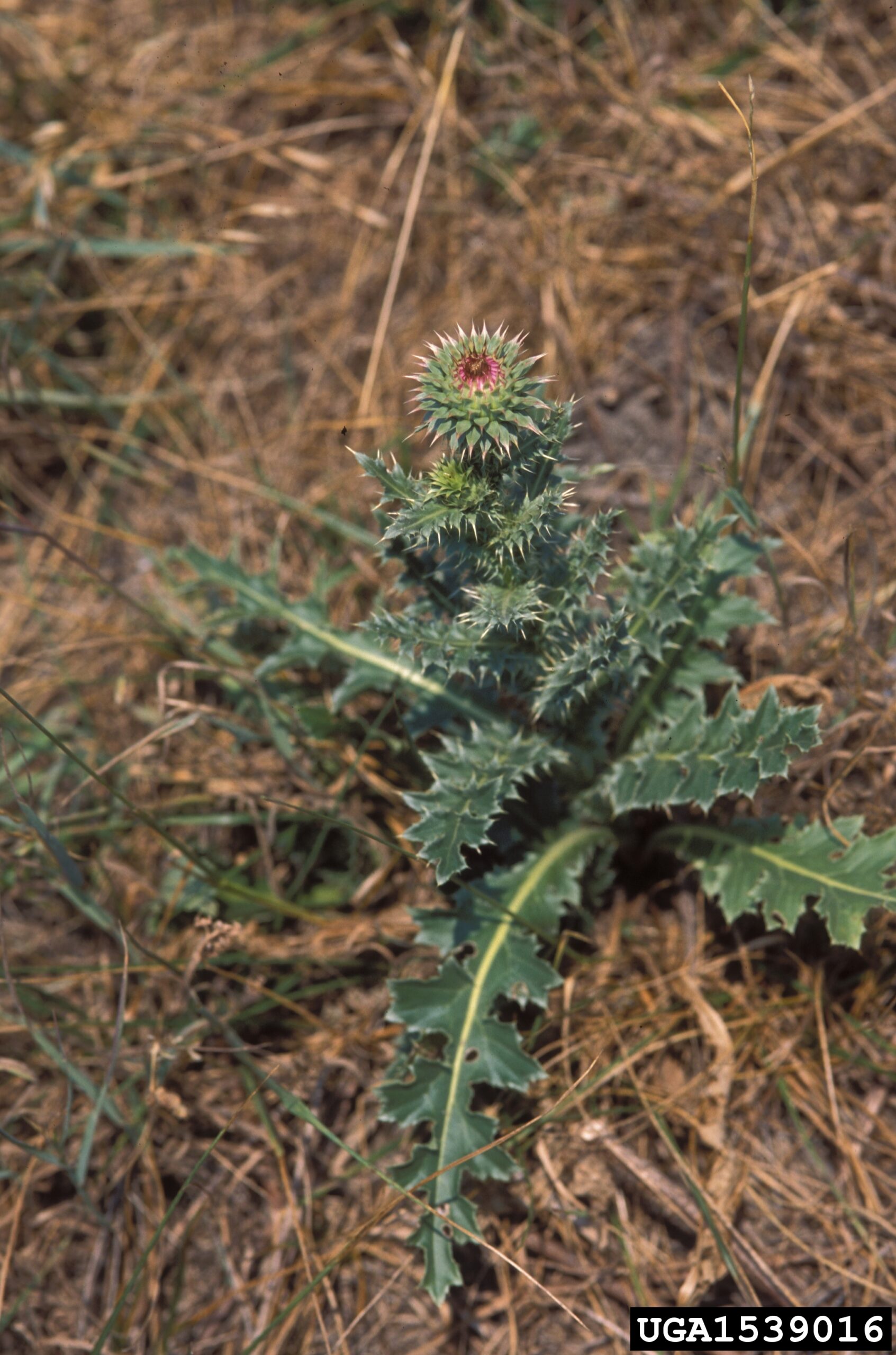
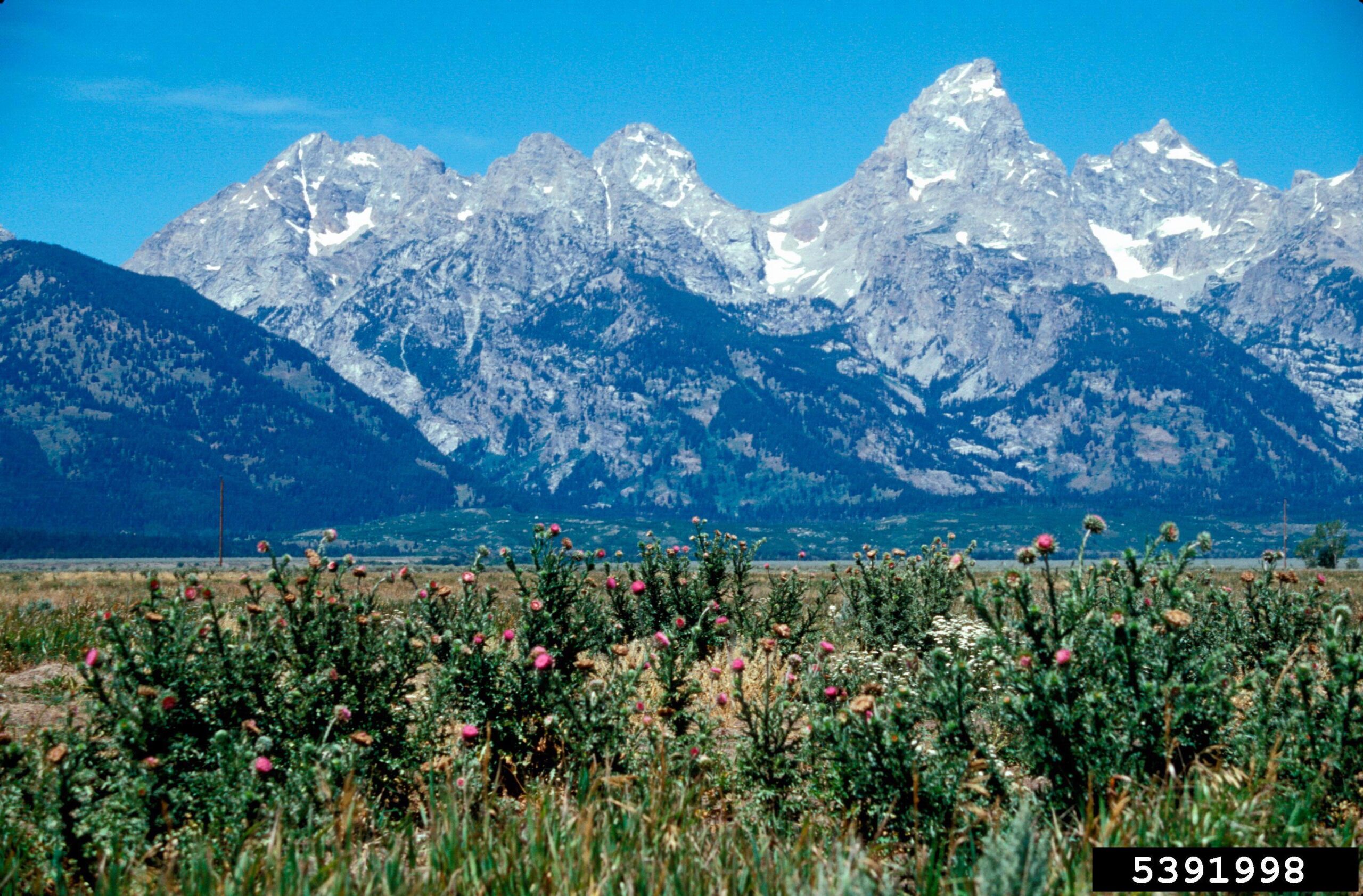
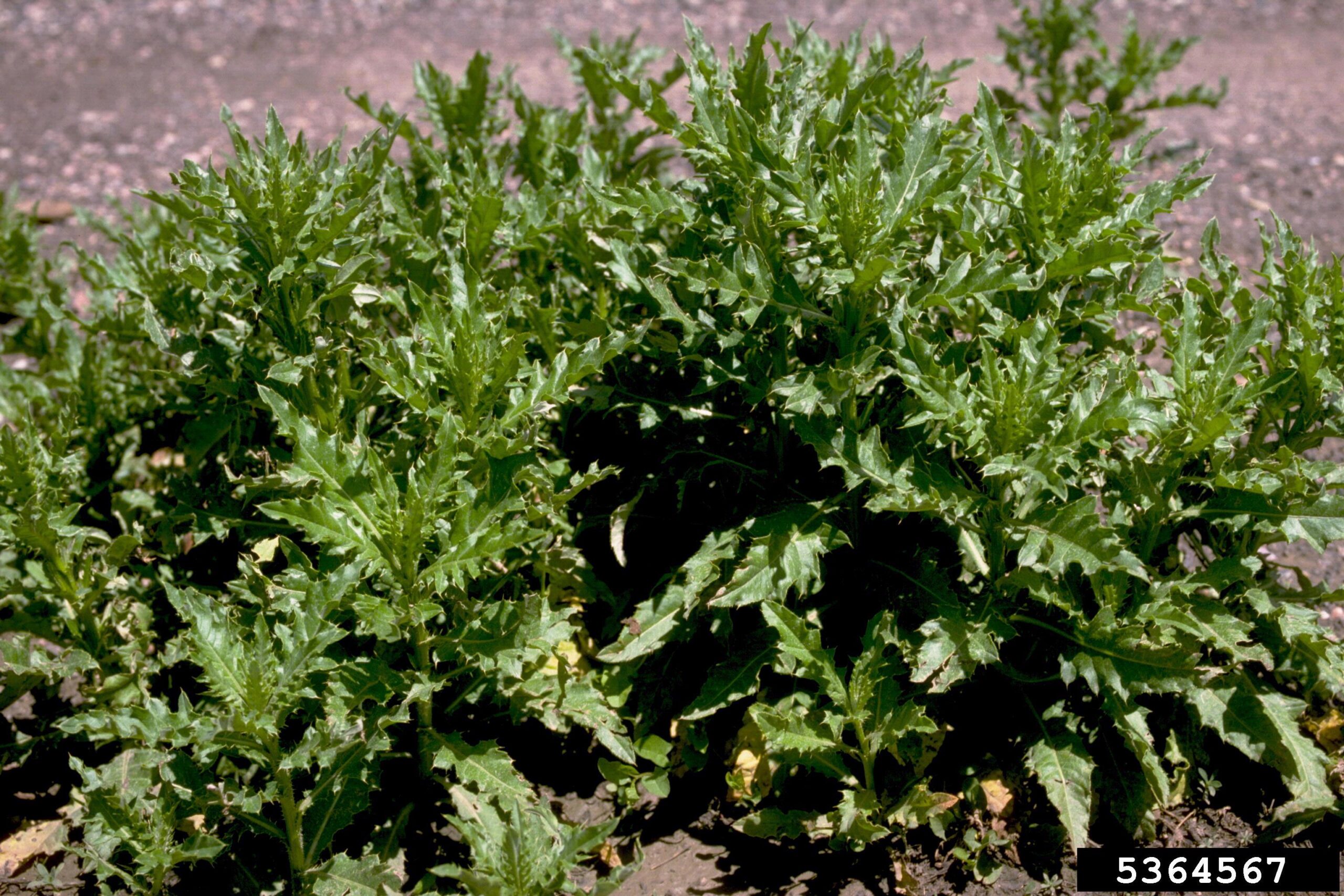
Musk Thistle is widespread in New Mexico and occurs in most counties. It takes 2 years to fully grow, spending its first year as a rosette (a series of large leaves arranged in a circular pattern at the base) and sprouting its large stem and flower in the second year. It is easy to distinguish this thistle by its large flower that will droop to the ground, and its leaves have no fuzzy hair. Grazing animals will avoid it because it is too spiky to eat, and overgrazing the land will suppress any competition it might have faced. Because most seeds won’t travel far from the plant, the result is a dense monoculture of this invasive plant. [2] [5]
History of Musk Thistle
The musk thistle’s native habitat is wide, ranging from western and central Europe, northwards to Scotland, and extending to Sicily, central Yugoslavia, Ukraine, western Siberia, Asia Minor, and North Africa. In its native land, its population was kept in check by natural disease and predators that were not present in North America. Musk thistle was introduced to the United States in the mid-1800s and was recorded multiple times along the East Coast by the late 1800s. In the early 20th century, it began to appear in the Midwest, and by the 1940s, it was considered a potential problem in North America. Today, Musk Thistle can be found across most of the US and southern Canada. [1][15]
2. ID Guide
What does it look like?
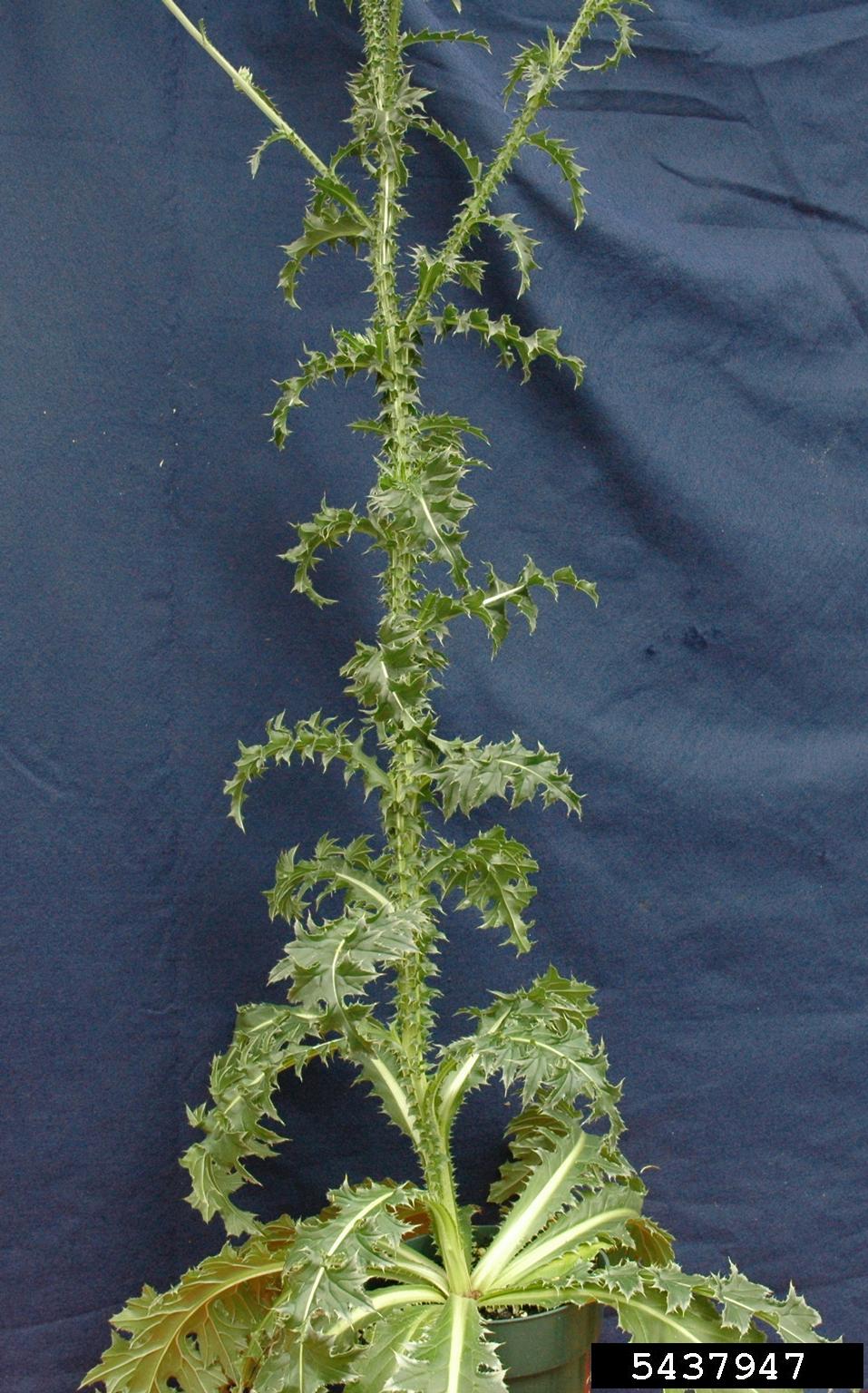
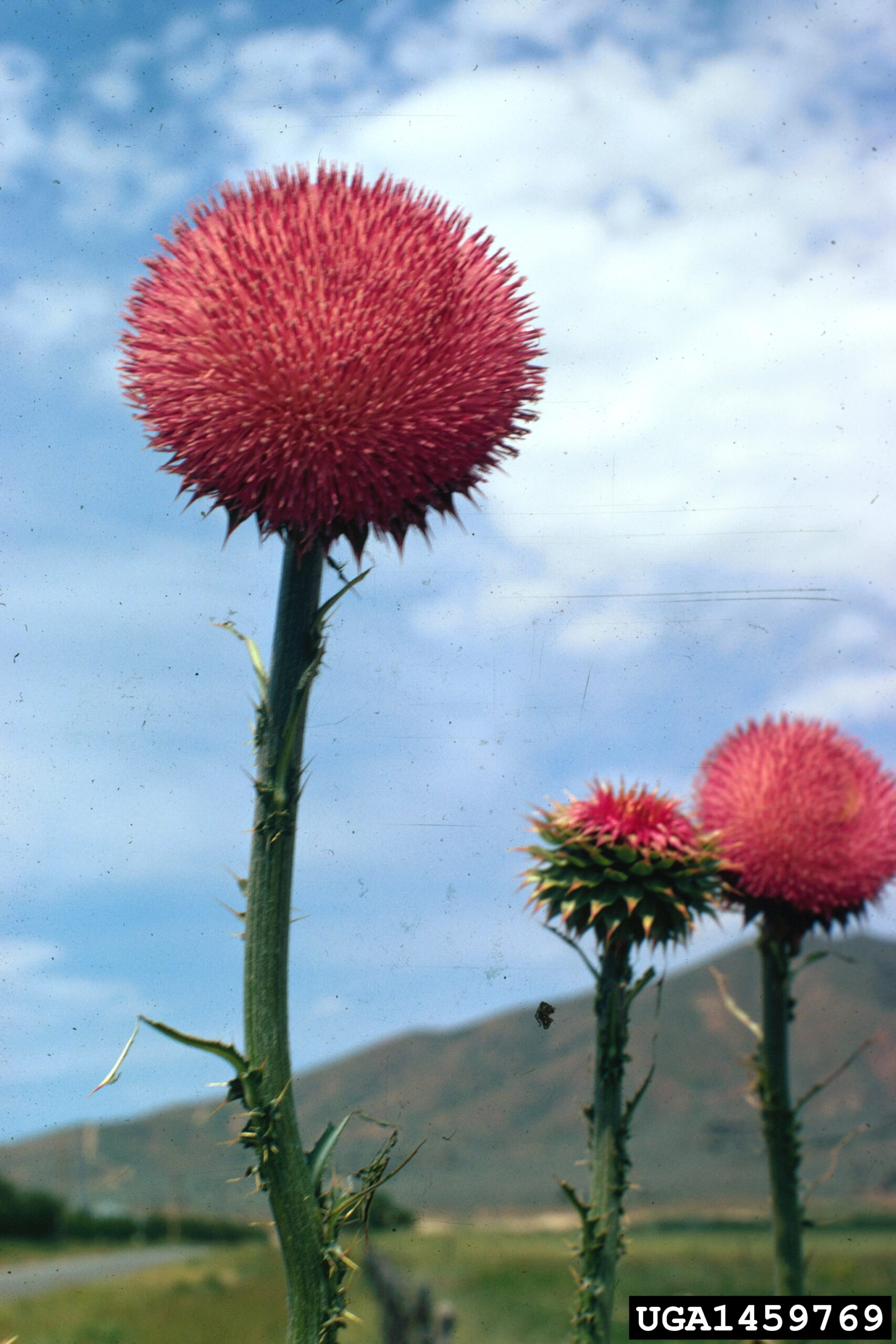
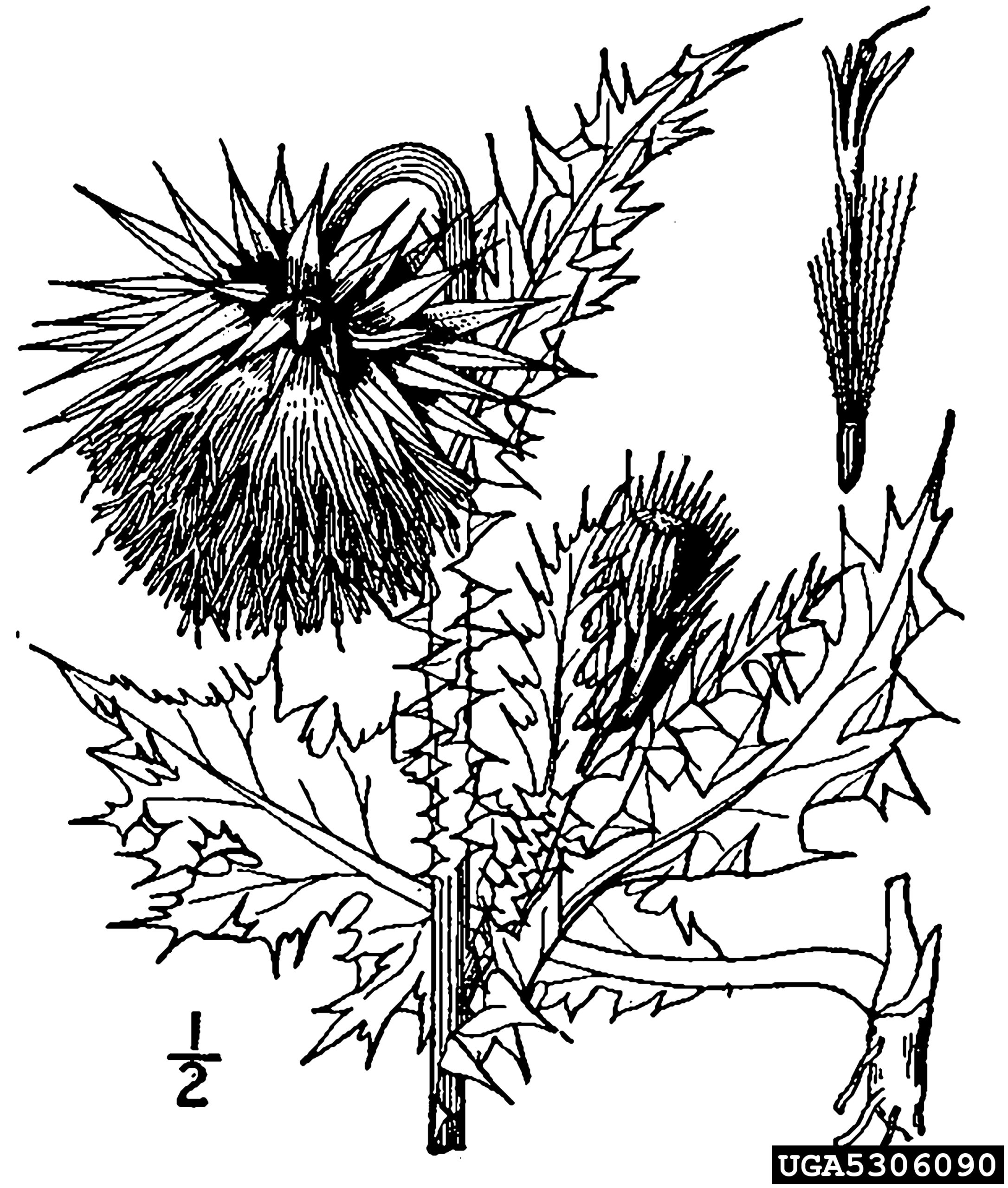
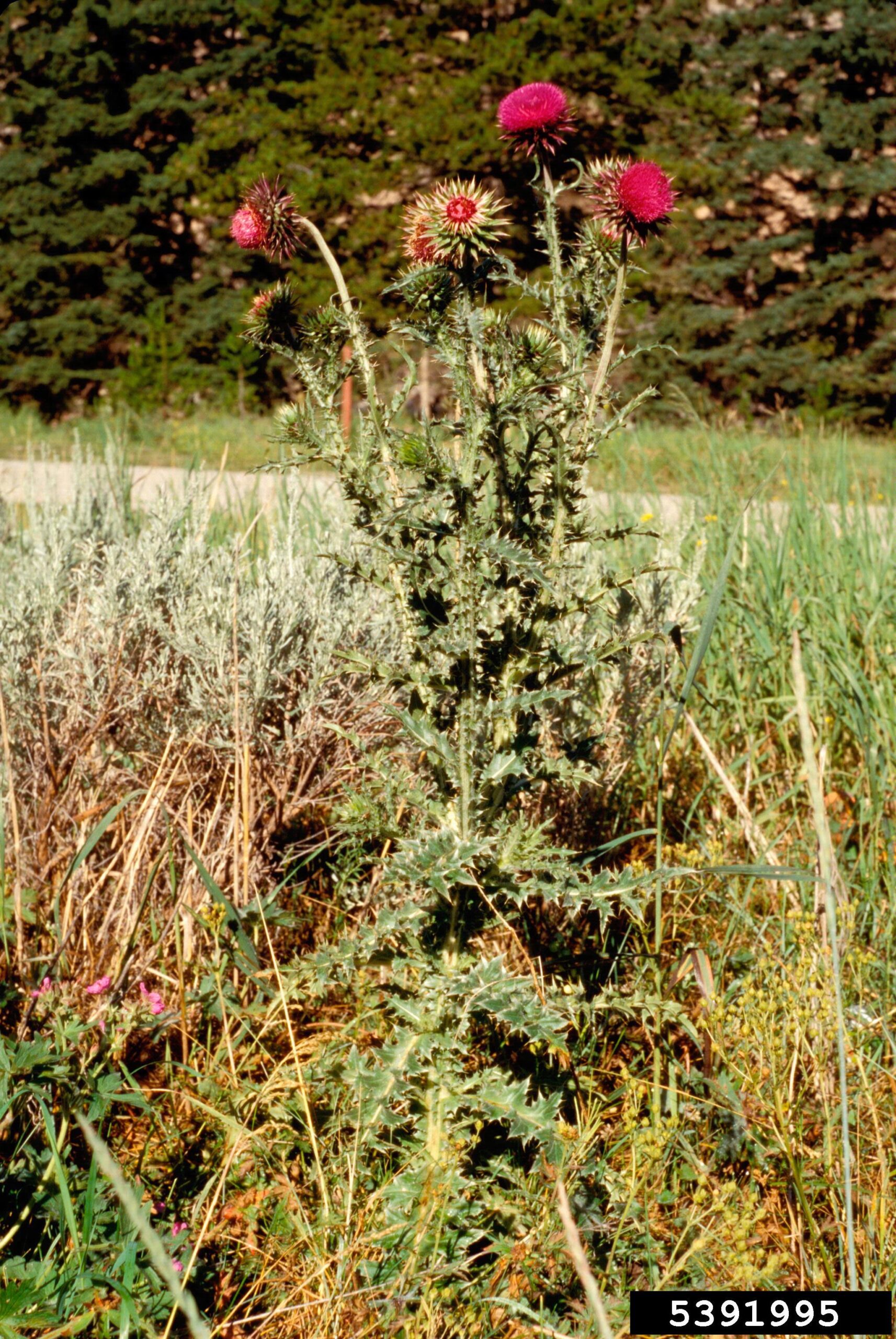
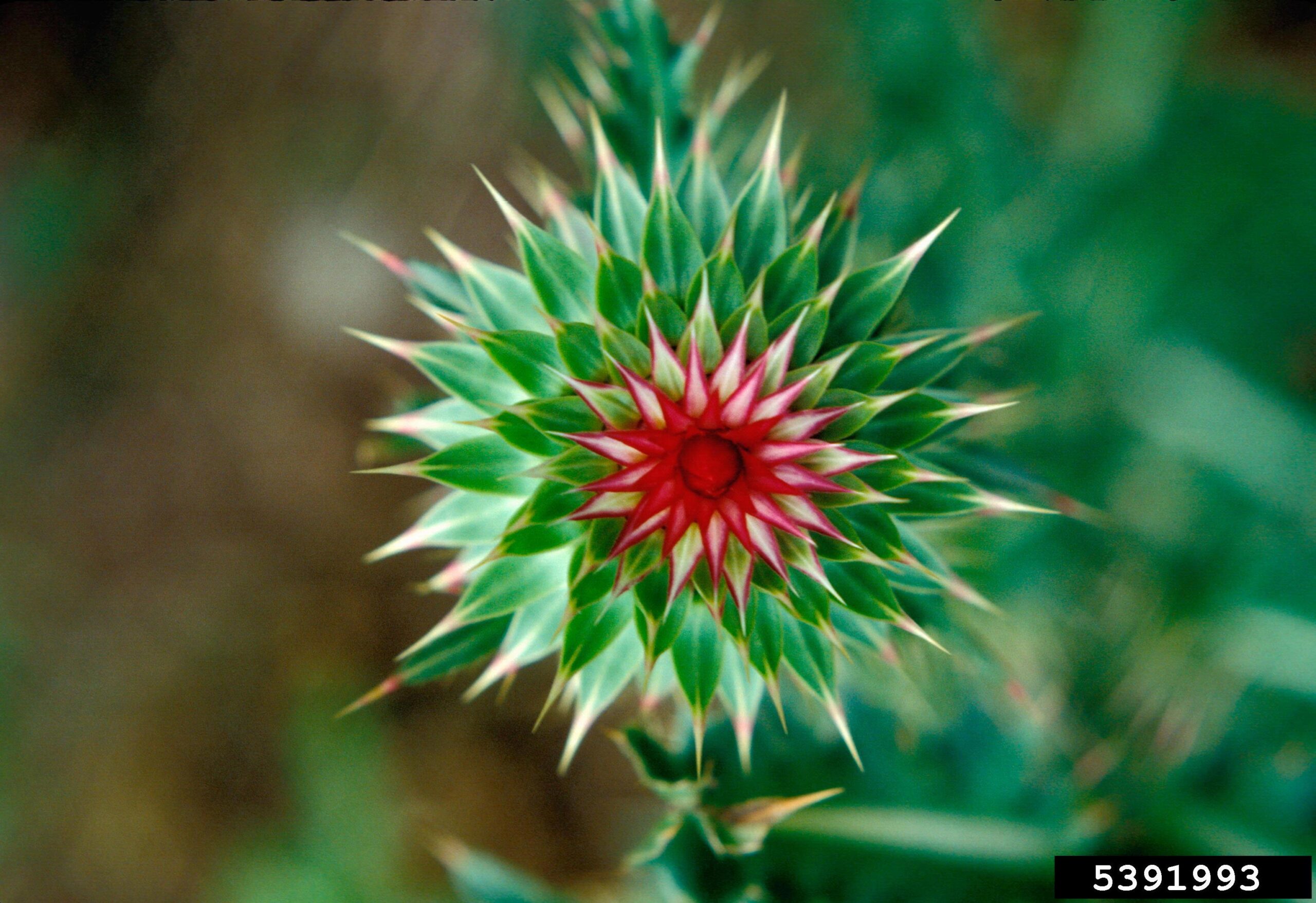
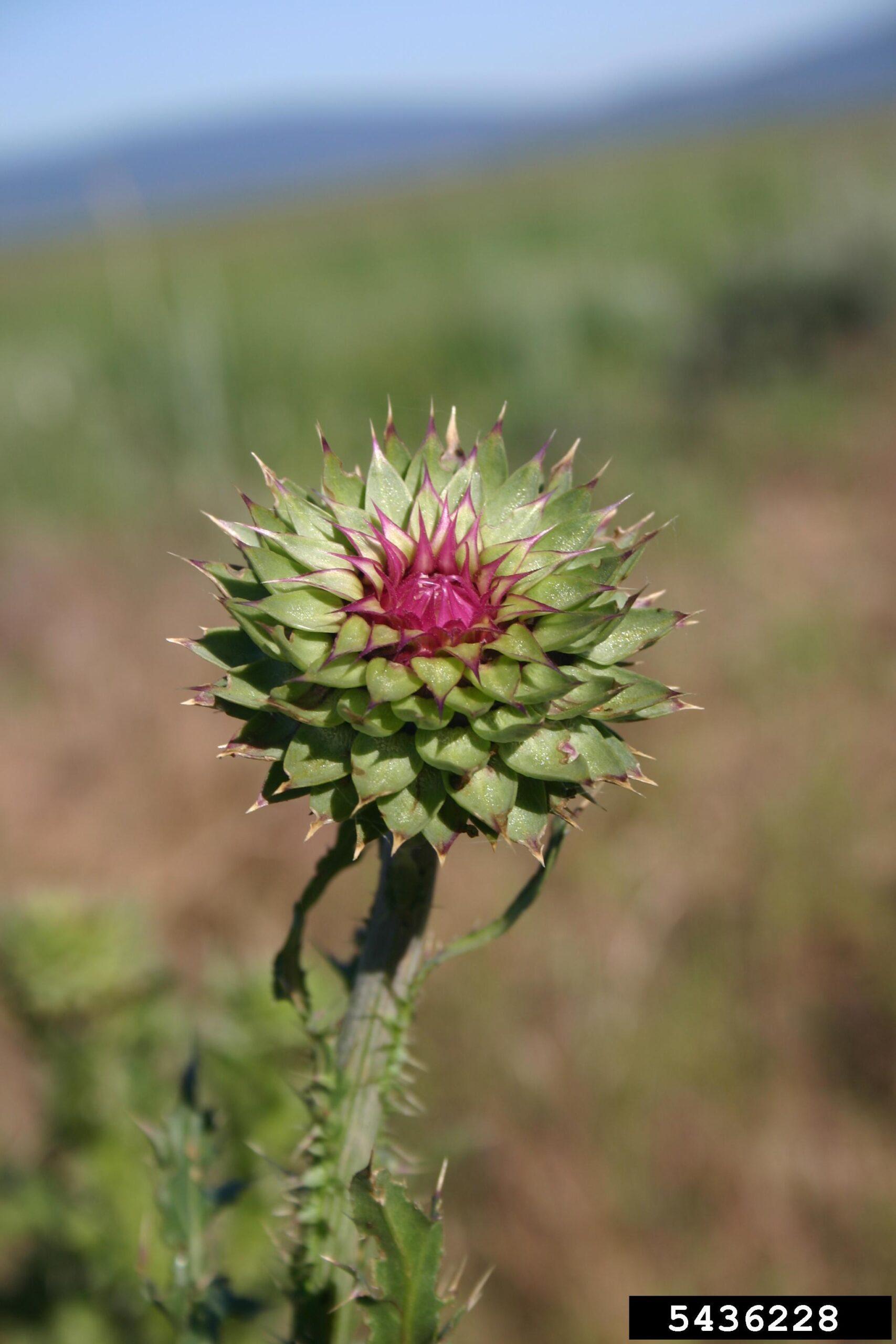
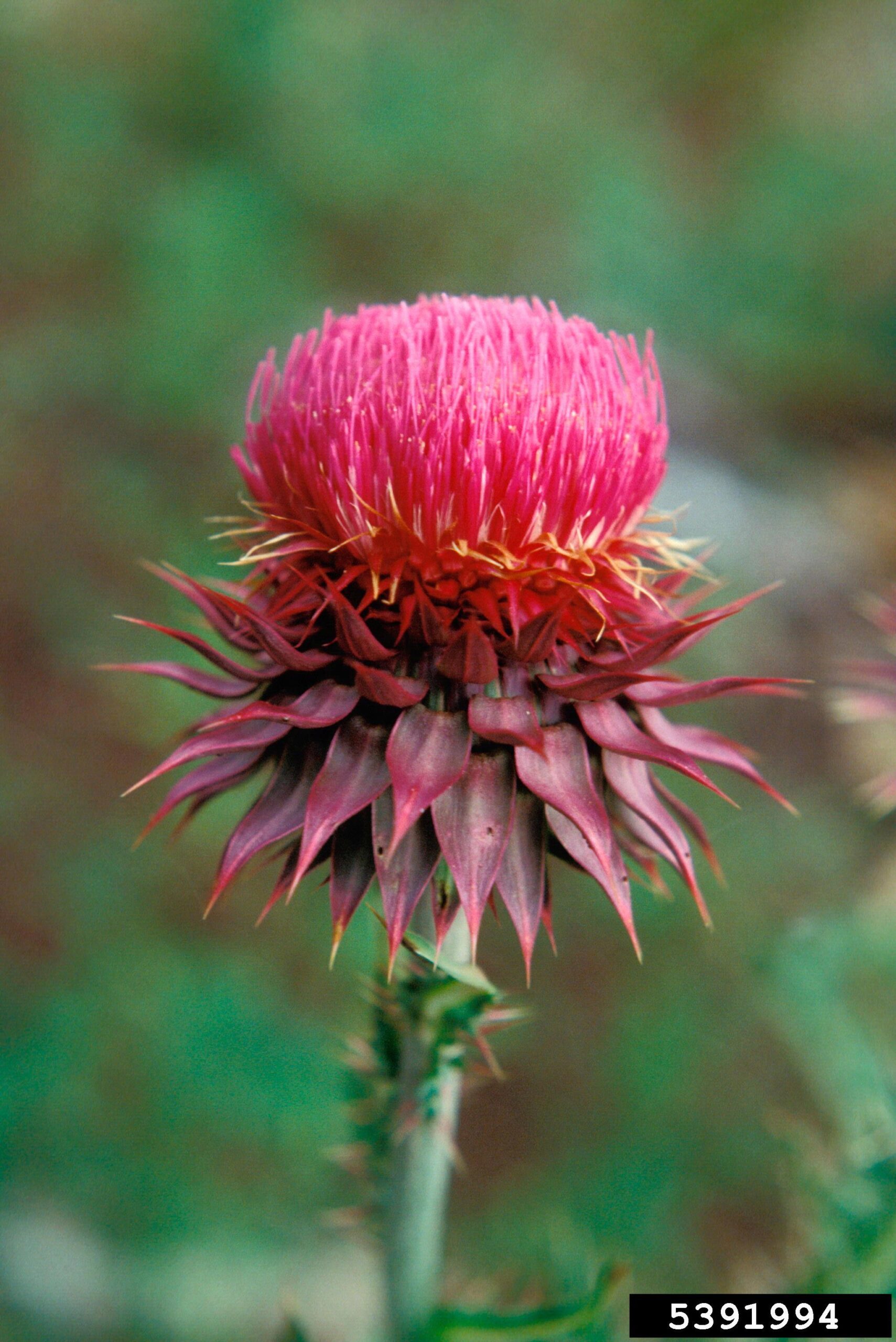
Musk Thistle is characterized by its large flowers (2 to 3 inches in diameter), their deep rose to violet color, and their tendency to droop toward the ground. The Stem can stand 3 to 8 feet tall with spines along it. The leaves have silvery margins and, unlike other Thistles, lack hair and fuzz on their surfaces. [2]
Having trouble identifying a weed?
Contact your local conservation district or county extension agent.
Key Features
- Plant: Like the Bull and Scotch Thistle, the Musk Thistle is a biennial plant, producing a rosette in the first year and sprouting its stem and flowers in the second. After producing seeds, the plant will die.
- Roots: Large, fleshy, corky taproot that is hollow near the surface. [3]
- Leaves: Dark green with a light green mid-rib and mostly white margins. The leaves should be hairless on top and bottom with spines along the edges. [3]
- Flowers: Around 2 to 3 inches in diameter, purple to deep rose, rarely white. Behind the flower, there are needle-like bracts that connect to the stem [3]
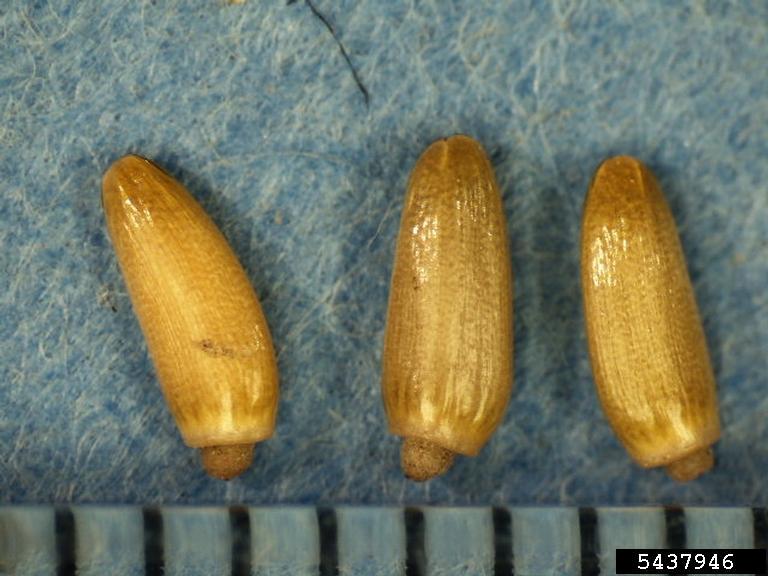
- Seeds: 1/8 to 3/16 inches long, shiny, striated, yellow-brown, with a hairlike plume. Each flower can produce up to 10,000 seeds, of which 33% are viable, yielding 3,600 seedlings. They can survive for more than a decade in the soil, and it can take 15 years to reduce the number of viable seeds to below 1%. [3]
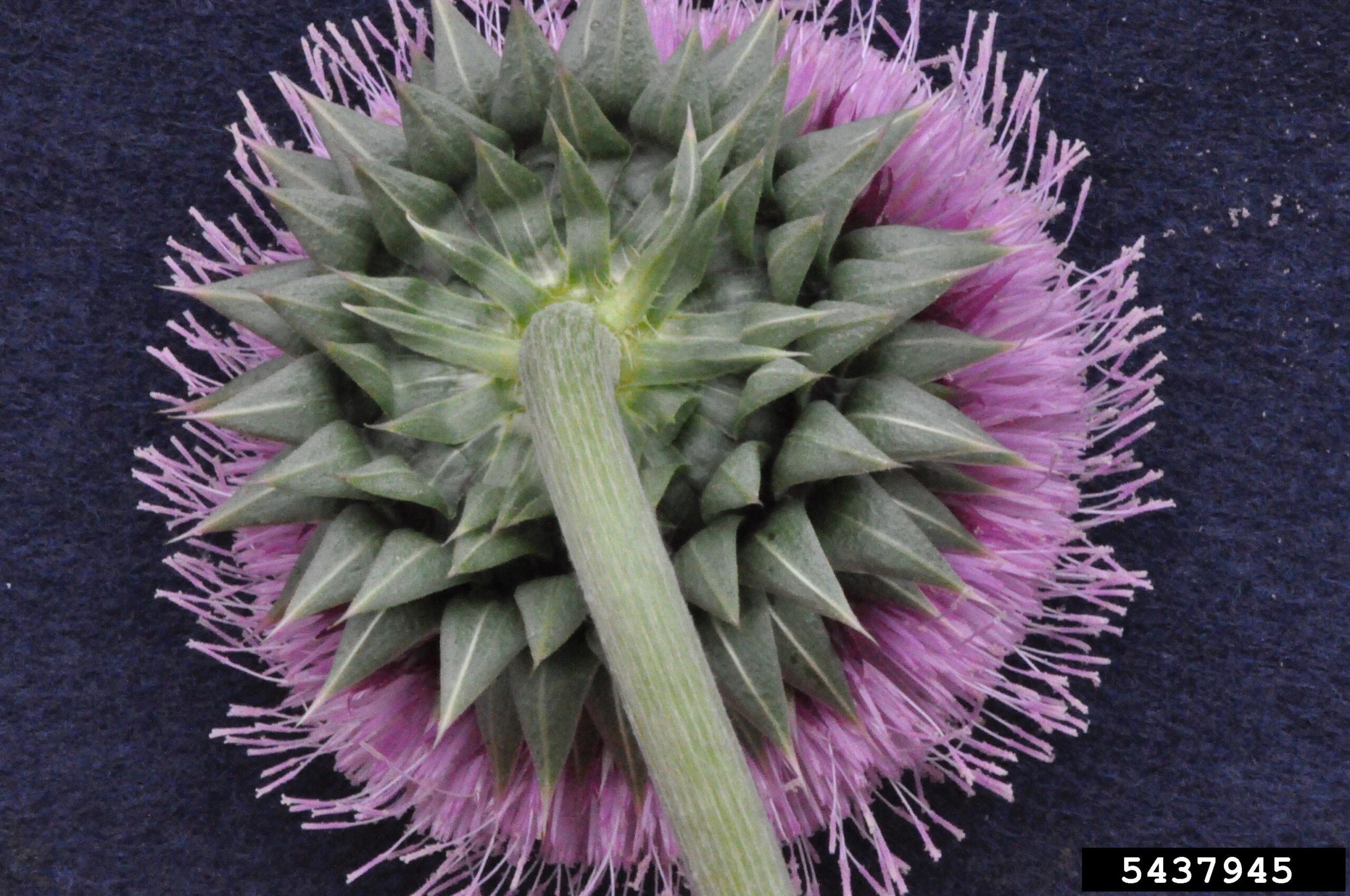
Bruce Ackley, The Ohio State University, Bugwood.org
Behind the flower, there are needle-like bracts that connect to the stem.
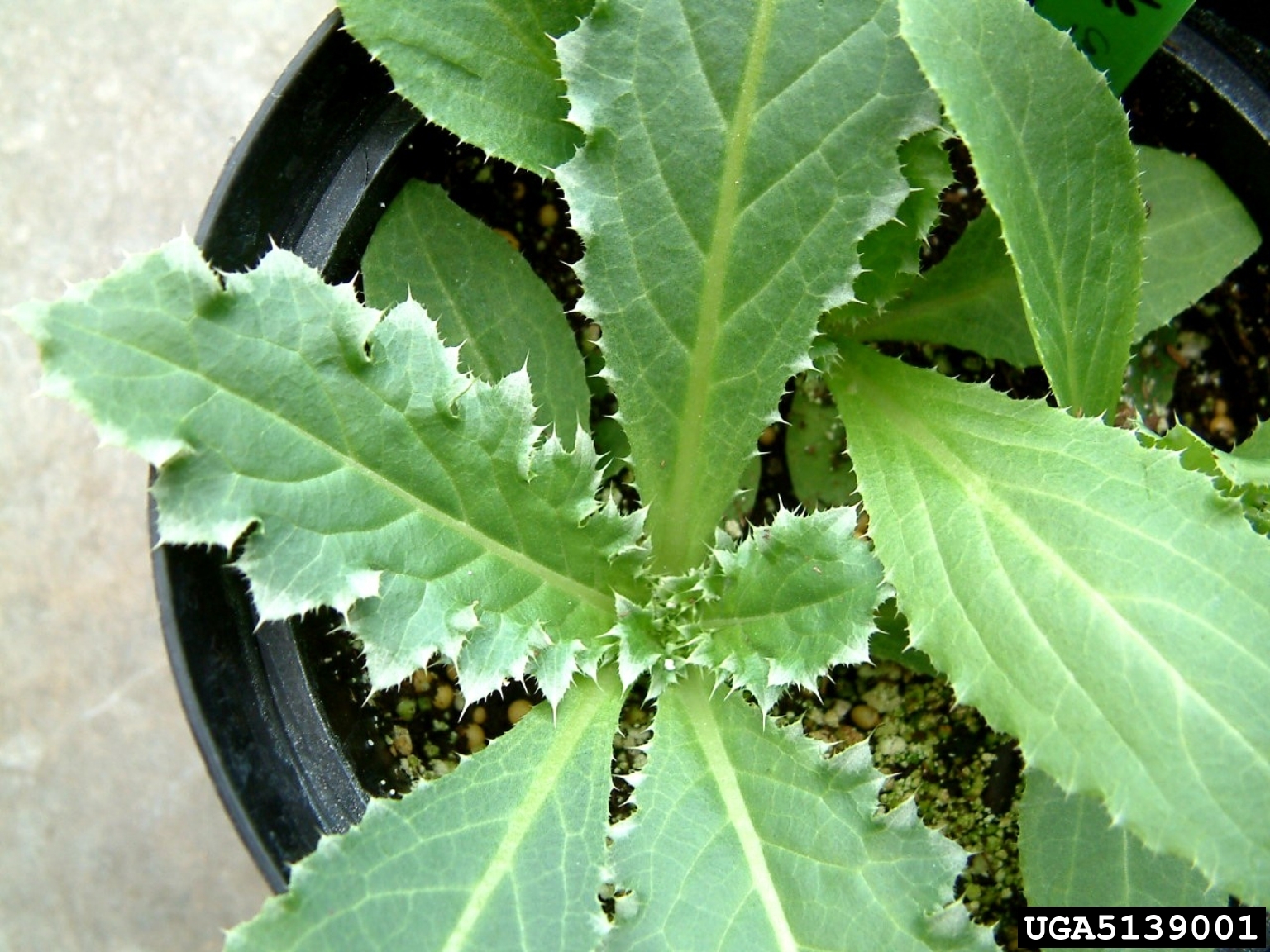
Lynn Sosnoskie, University of Georgia, Bugwood.org
Like the Bull and Scotch Thistle, the Musk thistle is a biennial plant, producing a rosette in the first year and sprouting its stem and flowers in the second.
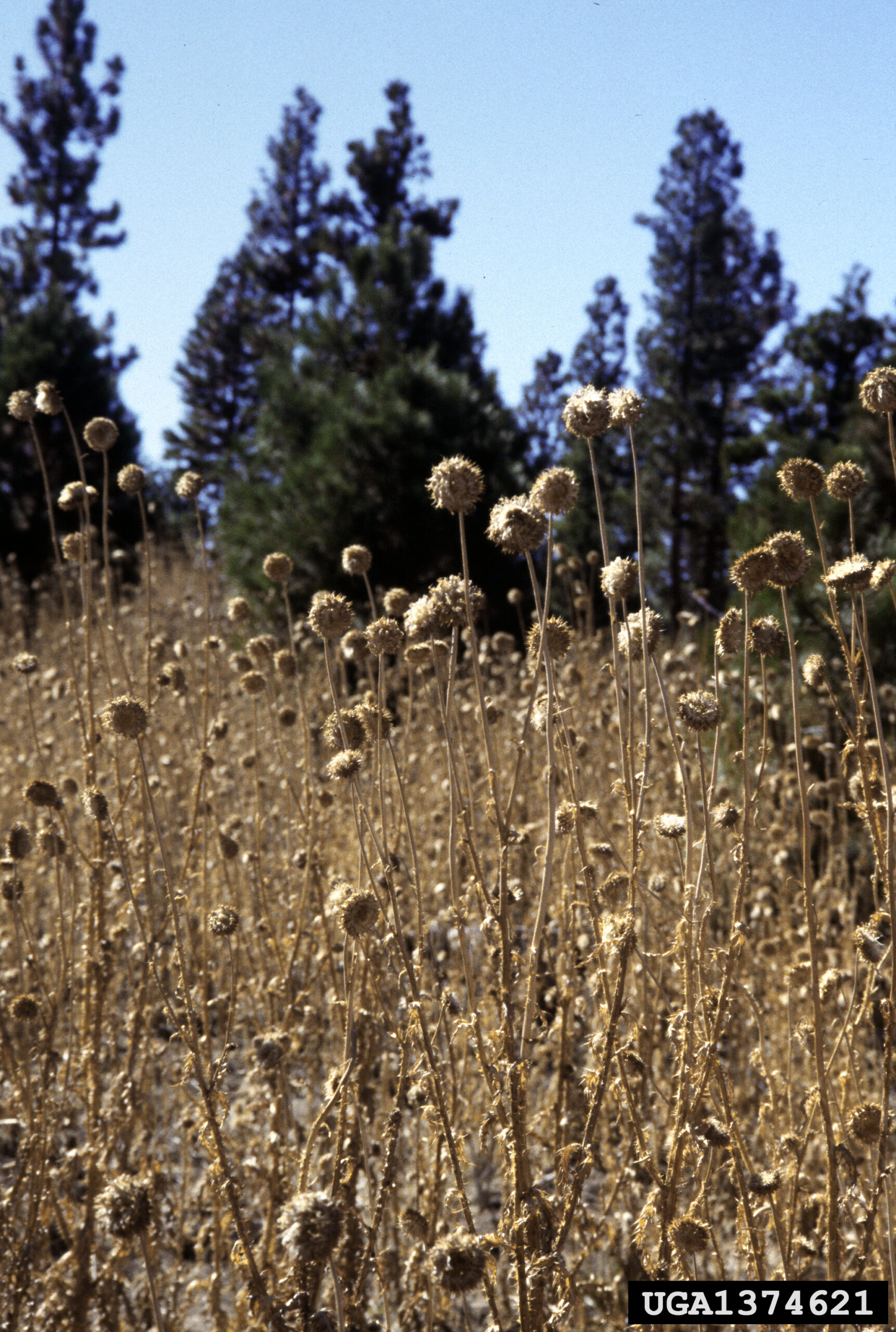
Terry Spivey, USDA Forest Service, Bugwood.org
After producing seeds, the plant will die.
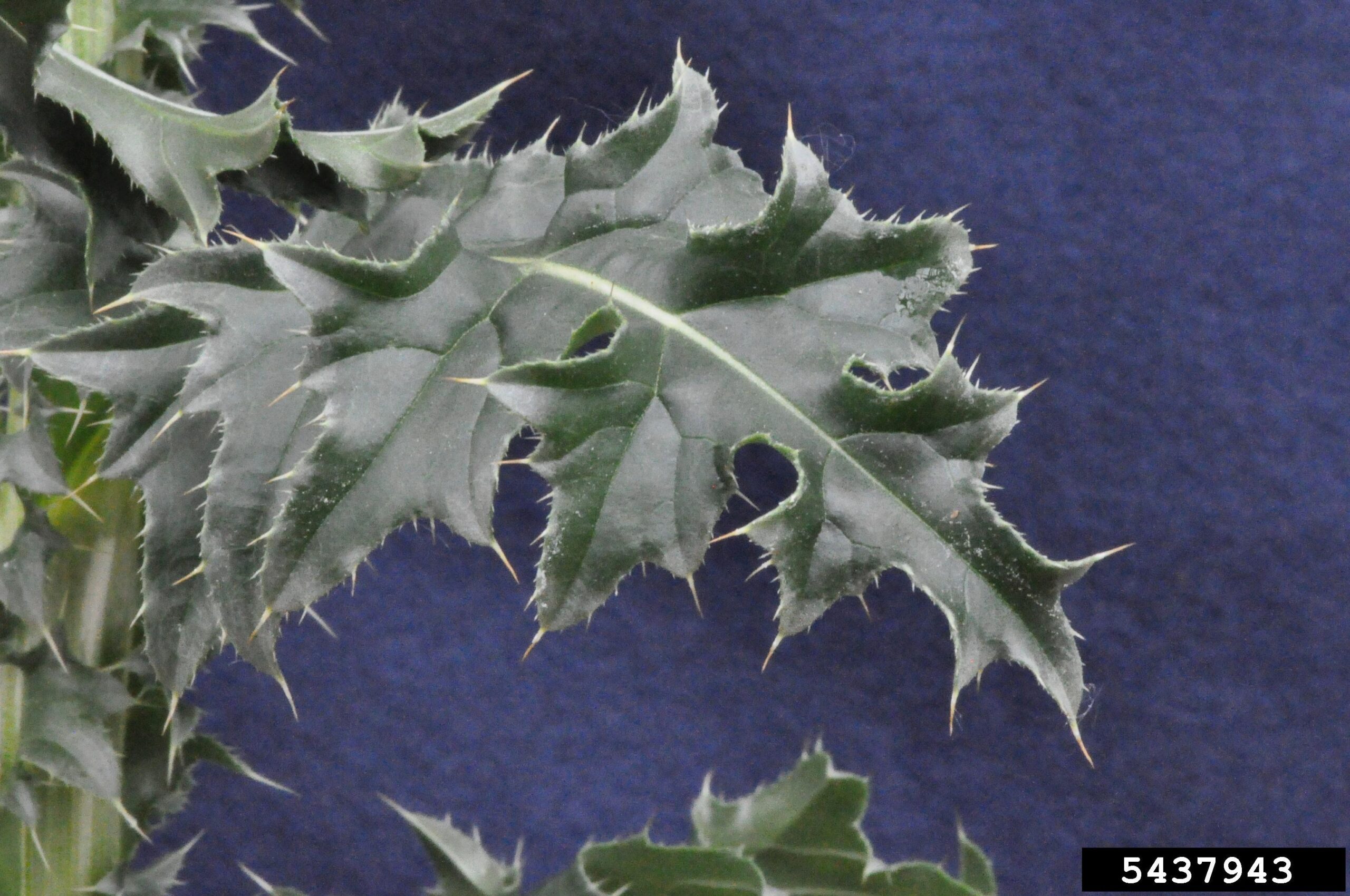
Bruce Ackley, The Ohio State University, Bugwood.org
The leaves should be hairless on top and bottom with spines along the edges.
Bruce Ackley, The Ohio State University, Bugwood.org
The Stem can stand 3 to 8 feet tall with spines along it.
Bruce Ackley, The Ohio State University, Bugwood.org
Seeds are 1/8 to 3/16 inches long, shiny, striated, yellow-brown, with a hairlike plume.
3. Infestation Basics
“The prickly habit of thistles needs no comment, and all animals, save the donkey, are afraid to approach such well-armed plants. The spines on this species are very strong, and the large, handsome, reddish-purple flowers expand from May to October.”
– Anne Pratt, 1899
Where and how does it grow, and how does it spread?
Musk Thistle grows best when the soil is damp and plenty of light is available. They spend 90% of its life as a rosette, staying near the ground until the stem bolts upward, flowers, produces seed, and dies. [3]
The Musk thistle spreads by water, wildlife, livestock, and human activity. While less than 1% of seeds are effectively transported by wind, it still poses a risk, as just one seed can start an infestation. [3]
Key takeaway: Musk Thistle can remain in the seed bank up to 15 years, so constant vigilance is needed after an infestation.
Why is it so invasive?
Musk Thistle produces many seeds, which can remain in the seed bank for up to 15 years. They are avoided by livestock, which will eat around them, creating the perfect environment for a continued infestation in overgrazed land.
Carduus nutans is a highly competitive invasive species capable of displacing substantial portions of native vegetation in pastures and other disturbed environments. Because musk thistle is unpalatable to both wildlife and livestock, grazing animals selectively avoid it and concentrate their foraging on more palatable native plants. This selective grazing accelerates the degradation of native meadows and grasslands. As surrounding vegetation is repeatedly consumed, musk thistle remains untouched, allowing it to grow vigorously, outcompeting native species, and becoming a significant pest in grazing systems. [12]
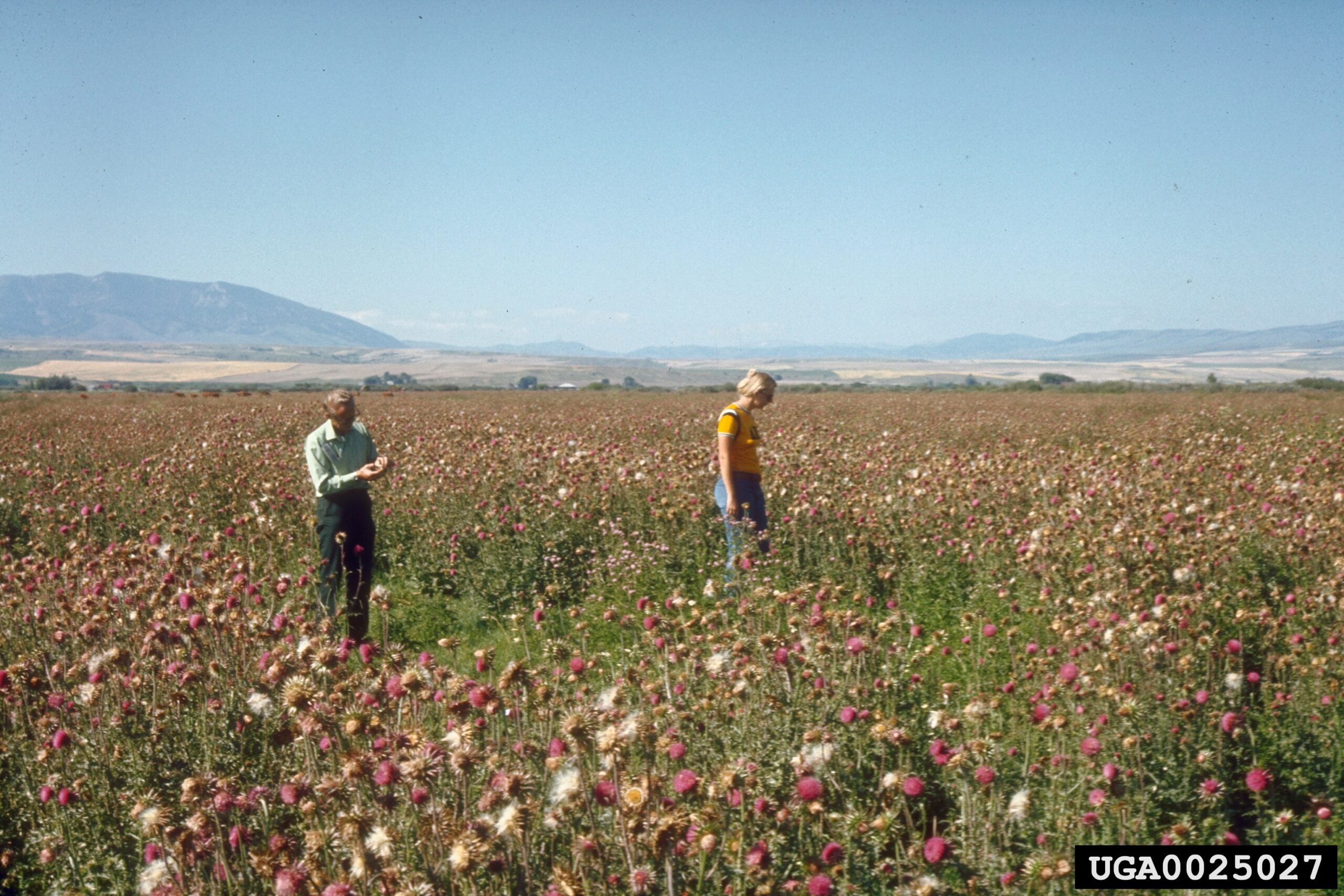
Under optimal environmental conditions, musk thistle can form extremely dense monospecific stands, with reported densities of approximately 60,000 individuals per acre. Such infestations are often characterized as self‑perpetuating due to their capacity to suppress and, in some cases, nearly eliminate co‑occurring vegetation. Emerging evidence further indicates that musk thistle may synthesize and release allelopathic secondary metabolites that inhibit germination and growth of neighboring plant species, thereby facilitating its own recruitment, persistence, and competitive dominance. [13]
Key takeaway: Musk Thistle, once established, can be extremely difficult to eradicate, as its seeds can remain in the soil for up to 15 years, and it is not as readily consumed by wildlife or livestock as native plants.
Common risk factors for invasion
- Soil disturbance/ Open spaces: Musk Thistle seedlings require open spaces with adequate sunlight in order to become established in an area. As most seeds will only fall 50 inches from the parent plant, ensuring healthy competition should delay their spread. [3]
- Moisture availability: Musk Thistle needs somewhat moist soil to become established and seems to prefer abundant spring moisture; it has been shown that it can reach flowering stages with as little as 10 inches of annual rainfall. [1]
- Overgrazing: As livestock avoid eating the Musk Thistle, they will eliminate any competition that the Musk Thistle could have faced, and if allowed to overgraze, will provide conditions for a continued infestation.
Impacts
Ecosystem Health
Areas that are overgrazed could promote a Musk Thistle infestation, but the seedlings appear to be sensitive to competition, especially when it reduces light availability. [3]
Health and Safety
The edges of the leaves and the stem have needles, which can be painful if handled with bare hands. There are no known toxins in musk thistle, but it is frequently sprayed with herbicides to control its population. [11]
Economic
Areas that are overgrazed could promote a Musk Thistle infestation, but the seedlings appear to be sensitive to competition, especially when it reduces light availability. [3]
Agriculture and Food Security
While livestock can feed on the flowers, the stems and leaves are too thorny to consume and tend to be avoided when grown. In fact, livestock will avoid areas near the plants, resulting in reduced grazing capacity. [6]
4. Management Strategies
Effective management of Musk Thistle requires persistent effort, as the seeds can remain in the soil for up to a decade, and it can take 15 years to eliminate them. They only spread through seeds, so as long as the plants are removed before the flowers come out, there will be a positive impact on their population. [3]
They favor a wet ground in a poor vegetative state and respond positively to soils with an excess of nitrogen. Musk thistle seedlings’ growth directly correlates to the amount of light they receive, so an effective control method is to prevent sunlight from reaching them by ensuring competition from native perennial grasses and not letting overgrazing remove their competition. [3]
There are insects called the Head weevil and, to a lesser extent, the Rosette weevil that target the Musk Thistle; they were released in the 60s to combat the plant. However, due to the risk they posed to native thistles, it is now illegal to release them, and they no longer seem to be available for sale. They can still be found in nature and were seen in Taos County, NM as recently as 2023. [8][9][10]
DO’s
- Severing the plants from the roots will kill them, as new growth can only come from seeds.
- Remove the plants before they have the chance to produce seeds.
- Plant perennial grasses that can outcompete the thistle.
DON’Ts
- Avoid having any large amount of land that is both moist and devoid of local perennial grasses
- Don’t use fire! It can create favorable conditions for the Thistle to return.
- Don’t mow during or after flowering to prevent seed dispersal.
** The following information is provided courtesy of the UC Weed Research and Information Center. nmweeds.taosswcd-nm.gov does not endorse the use of any particular product, brand, or application thereof. **
Non‑chemical management of musk thistle relies on interrupting its seed cycle and strengthening competition from perennial grasses.
These thistles can be cultivated or manually removed when small. To control by cutting, use a sharpened shovel at the top of the root crown. Grubbing hoes must cut the plants 2 to 4 inches below ground level to prevent resprouting from dormant axillary buds. Mowing the plant during flowering can greatly reduce seed production, though a single mowing is seldom sufficient due to the wide differences in the maturity of plants in a natural population. For mowing, wait till plants bolt and are about to flower. This may require repeated visits at weekly intervals over the 4 to 7 week blooming period, because not all plants bloom simultaneously. Plants will regrow if mowed before they are fully bolted. Plants cut 4 days after the first flowers open can produce viable seed.
Large livestock tend to avoid grazing on thistles, although horses and cattle have been known to eat the flowerheads. Sheep will eat the rosettes. Goats like the flowerheads and are able to digest the seed. Depending on timing, the soil seedbank, the plant community, and other factors, fire may help control thistles or may promote their invasion. Grass fires may not be hot enough to kill the root crown of thistle rosettes, but a flamer can be used to kill individual plants. In general, thistles compete poorly with healthy established grasses and other vegetation. Establishment of selected, aggressive grasses can be an effective cultural control of thistles.
The thistle head weevil (Rhinocyllus conicus) is an introduced biocontrol agent that attacks Carduus species and several other thistles. It is established in much of the northwestern and north-central United States. The weevil gives effective control of musk thistle in parts of Montana, less so in other areas. The crown weevil (Trichosirocalus horridus) and thistle crown fly (Cheilosia corydon) also are locally established. The fungus musk thistle rust (Puccinia carduorum) may soon be approved as a biocontrol agent.
- CHEMICAL CONTROL
- Growth Regulators
- Aromatic Amino Acid Inhibitors
- Branched Chain Aminoacid Inhibitors
- Photosynthetic Inhibitors
The following specific use information is based on published papers and reports by researchers and land managers. Other trade names may be available, and other compounds also are labeled for this weed. Directions for use may vary between brands; see label before use. Herbicides are listed by mode of action and then alphabetically. The order of herbicide listing is not reflective of the order of efficacy or preference.
|
2,4-D Several names |
Rate: 1 to 2 qt product/acre (0.95 to 1.9 lb a.e./acre) Timing: Postemergence in the rosette stage. Remarks: 2,4-D is broadleaf-selective and has no soil activity. It may require repeat application. It is not the most effective treatment, but is widely used because of low cost. Do not apply ester formulations when outside temperatures exceed 80°F. |
|
Aminocyclopyrachlor + chlorsulfuron Perspective |
Rate: 3 to 4.5 oz product/acre Timing: Postemergence in spring up to flowering, or in fall rosette stage. Remarks: Perspective provides broad-spectrum control of many broadleaf species. Although generally safe to grasses, it may suppress or injure certain annual and perennial grass species. Do not treat in the root zone of desirable trees and shrubs. Do not apply more than 11 oz product/acre per year. At this high rate, cool-season grasses will be damaged, including bluebunch wheatgrass. Not yet labeled for grazing lands. Add an adjuvant to the spray solution. This product is not approved for use in California and some counties of Colorado (San Luis Valley). |
|
Aminopyralid Milestone |
Rate: 4 to 5 oz product/acre (1 to 1.25 oz a.e./acre) Timing: Preemergence in winter to early spring and postemergence to seedling treatments in spring up to flower bud stage. Can be applied in fall in cold-winter areas. Apply when plants are at the late bolt through early flowering stages. For late applications starting at the late bud stage, 2,4-D at 1 lb ae/acre should be tank-mixed with Milestone. Remarks: Aminopyralid is one of the most effective herbicides for thistles. It is a broadleaf herbicide like picloram, but more selective and with a shorter soil residual activity. Aminopyralid is generally safe on grasses. It has longer soil residual and higher activity than clopyralid. |
|
Aminopyralid + 2,4-D, Aminopyralid + Aminopyralid + triclopyr,
|
Rate: 1.5 to 2 pt Forefront HL/acre; 1 to 3 oz Opensight/acre; 4 to 6 pt Capstone/acre Timing: Postemergence in rosette to bolting stages. Remarks: These combinations are broadleaf-selective. Opensight is not registered for use in California.
|
|
Clopyralid Transline |
Rate: 0.25 to 1.33 pt product/acre (1.5 to 8 oz a.e./acre) Timing: Postemergence in spring, up to the flower bud stage. Remarks: Clopyralid is a broadleaf herbicide that is more selective to some broadleaf plants than picloram. It is very safe on grasses. |
|
Clopyralid + 2,4-D Curtail
|
Rate: 2 to 4 qt product/acre (use higher rate if plants are drought-stressed) Timing: Postemergence to rapidly growing weeds from full rosette to early flower bud. Remarks: The combination is broadleaf-selective with a wide range of susceptible species.
|
|
Dicamba Banvel, Clarity |
Rate: 0.5 to 2 pt product/acre (0.25 to 1 lb a.e./acre); 8 to 16 oz product/acre for rosettes, up to 2 pt product/acre for bolting plants Timing: Postemergence to rapidly growing plants up to bolting. Application to smaller plants gives better control. Remarks: Dicamba is a broadleaf-selective herbicide often combined with other active ingredients. It is effective earlier in the season than 2,4-D. It is also effective when tank-mixed with 2,4-D (0.75 lb a.e./acre 2,4-D + 0.25 lb a.e./acre dicamba). Dicamba has very limited soil residual. Avoid drift to sensitive crops. Do not apply when outside temperatures exceed 80°F. Dicamba is available mixed with diflufenzopyr in a formulation called Overdrive. The combination is broadleaf-selective, but safe on most grasses. This has been reported to be effective on plumeless and musk thistle, and may have a similar effect on other members of the genus Carduus. Diflufenzopyr is an auxin transport inhibitor which causes dicamba to accumulate in shoot and root meristems, increasing its activity. Overdrive is applied postemergence at 4 to 8 oz product/acre on rapidly growing plants. Higher rates should be used on large annuals and biennials or when treating perennial weeds. Add a non-ionic surfactant to the treatment solution at 0.25% v/v or a methylated seed oil at 1% v/v solution. |
|
Fluroxypyr Vista XRT
|
Rate: 22 oz product/acre (7.7 oz a.e./acre) Timing: Postemergence to rapidly growing weeds. Remarks: Fluroxypyr is broadleaf-selective and safe on most grasses.
|
|
Picloram Tordon 22K |
Rate: 0.67 to 1 qt product/acre (0.33 to 0.5 lb a.e./acre) Timing: Postemergence during active growth before bud stage. Remarks: Picloram is one of the most effective herbicides for bull thistle control. Most broadleaf plants are susceptible, but relatively safe on established grasses. It is also effective when mixed with dicamba or 2,4-D. Picloram has long soil residual activity and has been reported by some to injure young or germinating grasses. Picloram can also be used in a premix with 2,4-D (Grazon P+D) to give control of bull thistle. Picloram products are federally restricted-use pesticides. Picloram and its formulations are not registered for use in California. |
|
Triclopyr Garlon 3A, Garlon 4
|
Rate: 1.33 to 2.66 qt Garlon 3A/acre or 1 to 2 qt Garlon 4 Ultra/acre (1 to 2 lb a.e./acre) Timing: Postemergence to rapidly growing weeds. Remarks: Triclopyr is broadleaf-selective and safe on most grasses. It is most effective on smaller plants. Garlon 4 Ultra is formulated as a low-volatile ester. However, in warm temperatures, spraying onto hard surfaces such as rocks or pavement can increase the risk of volatilization and off-target damage. Rates are based on those reported for Canada thistle. |
|
Triclopyr + 2,4-D Crossbow
|
Rate: 2 to 4 qt product/acre Timing: Postemergence during the rosette stage. Remarks: Include non-ionic surfactant at 1 qt/100 gal water (0.25% v/v).
|
|
Glyphosate Roundup, Accord XRT II,
|
Rate: 1.33 to 2.67 qt product (Roundup ProMax)/acre (1.5 to 3 lb a.e./acre) Timing: Postemergence to rapidly growing plants in the bud stage. Remarks: Glyphosate has no soil activity and is nonselective. Repeat applications may be necessary. It is more effective with the addition of ammonium sulfate. |
|
Chlorsulfuron Telar |
Rate: 1 to 2.6 oz product/acre (0.75 to 1.95 oz a.i./acre) Timing: Postemergence in fall to new rosettes, or to rosettes in spring before bolting. Chlorsulfuron or metsulfuron applied from the bolting through very early bud stage eliminated viable achene development. Remarks: Chlorsulfuron has mixed selectivity, but is generally safe on grasses. Use a surfactant. It can be used in late season applications to reduce seed production and has fairly long soil residual activity. Fall application may injure desirable bromes. |
|
Imazapic Plateau
|
Rate: 8 to 12 oz product/acre (2 to 3 oz a.e./acre) Timing: Preemergence or early postemergence. Only suppression of musk thistle when applied preemergence. Remarks: Imazapic has mixed selectivity and some soil residual activity. Although the label indicates that musk thistle can be controlled with imazapic, it generally tends to favor members of the Asteraceae and some grasses. Use a methylated seed oil surfactant at 0.25% v/v. Not registered for use in California.
|
|
Imazapyr Arsenal, Habitat, Stalker, Chopper, Polaris |
Rate: 3 to 4 pt product/acre (0.75 to 1 lb a.e./acre) Timing: Preemergence or postemergence. Remarks: Imazapyr is a nonselective herbicide. Rates are based on those reported for bull thistle. |
|
Metsulfuron Escort
|
Rate: 0.5 to 1 oz product/acre (0.3 to 0.6 oz a.i./acre) Timing: Postemergence to young, rapidly growing weeds in spring before flowering, or in fall to Remarks: Metsulfuron has mixed selectivity and is generally safe on grasses. Use a surfactant. It can be tank-mixed with aminopyralid (Opensight), 2,4-D and/or dicamba. Metsulfuron has some soil residual activity. It is not registered for use in California. |
|
Metsulfuron + chlorsulfuron Cimarron X-tra
|
Rate: 0.5 oz product/acre Timing: Postemergence before flowering. Remarks: It is not registered for use in California.
|
|
Sulfometuron Oust and others
|
Rate: 6 to 8 oz product/acre (4.5 to 6 oz a.i./acre) Timing: Preemergence or early postemergence, during the rainy season when weeds are germinating or rapidly growing. Remarks: Sulfometuron has mixed selectivity, but is fairly safe on native perennial grasses, especially wheatgrass. This rate is very high and may not be the best option. Desirable grasses may be stunted, stressed, or injured. Sulfometuron has fairly long soil residual activity.
|
|
Hexazinone Velpar L
|
Rate: 4 to 6 pt product/acre (1 to 1.5 lb a.e./acre) Timing: Preemergence before weeds emerge or postemergence to young plants. Remarks: Hexazinone has both foliar and soil activity. In soil applications, rates will vary with soil texture and soil organic matter; best results when applied to moist soil. Use rates will also vary depending on the weed species to be controlled. Hardwood trees near the application site can absorb this chemical through the roots and may be injured or killed. Do not spray near the root zone of desirable hardwood trees or shrubs. High rates of hexazinone can create bare ground, so only use high rates in spot treatments. |
5. Citations
[1] Zouhar, Kris. 2002. Carduus nutans. In: Fire Effects Information System, [Online]. U.S. Department of Agriculture, Forest Service, Rocky Mountain Research Station, Fire Sciences Laboratory (Producer). Available: https://www.fs.usda.gov/database/feis/plants/forb/carnut/all.html. Accessed 2026, May 27.
[2] M. Case, R.J. Tyrl, “Thistles in Oklahoma and Their Identification,” Oklahoma Cooperative Extension Service, https://www.fs.usda.gov/database/feis/pdfs/weeds/OK_State_thistle_ID.pdf. Accessed 2026, May 27.
[3] Sheley, Roger L., and Janet K. Petroff. Biology and Management of Noxious Rangeland Weeds. Oregon State University Press, 1999.
[4] “Rangeland-Pasture Recommendations Musk thistle Identification and Management”, Weld.gov,https://www.weld.gov/files/sharedassets/public/v/1/departments/public-works/documents/musk-thistle-2.pdf
[5] L. Beck and J. Wanstall ”Noxious and Troublesome Weeds of New Mexico”, New Mexico State University, https://pubs.nmsu.edu/_circulars/CR698/#a11
[6] J.T. Trumble and L.T. Kok. Integrated pest management techniques in thistle suppression in pastures of North America, European Weed Research Society, 1982. https://faculty.ucr.edu/~john/1982/Trumble-and-Kok-1982.pdf
[7] Carduus nutans L., Weed Research and Information Center, https://wric.ucdavis.edu/weed-reports/carduus-nutans-l
[8] W. H. Fick “MUSK THISTLE CONTROL“, Kansas State University Agricultural Experiment Station and Cooperative Extension Service, https://www.asi.k-state.edu/doc/forage/fora39.pdf
[9] R. Sivinski, “New Mexico Forestry Division Section 6, Segment 22 Progress Report,” USDI-Fish & Wildlife Service, September 30, 2008, https://www.emnrd.nm.gov/sfd/wp-content/uploads/sites/4/SacMtThist2008.pdf
[10] TWSCD, Nodding Thistle Receptacle Weevil, June 2, 2023, Inaturalist, https://www.inaturalist.org/observations/165197689. Accessed 2026, June 3.
[11] L., “Carduus nutans – L.”, “Plants for a Future”, https://pfaf.org/user/Plant.aspx?LatinName=Carduus+nutans Accessed 2026, June 3.
[12] “Musk Thistle / Nodding Thistle”, Texas Invasive Species Institute, https://tsusinvasives.org/home/database/carduus-nutans Accessed 2026, June 4.
[13] J. Mangold, “Musk thistle (Carduus nutans)”, Montana State University, https://www.montana.edu/extension/invasiveplants/extension/monthly-weed-posts/2017_february.html Accessed 2026, June 4.
[14] O. Aon, “Eating Invasive Thistles: How to Forage Musk Thistle”, Forage Colorado, https://www.foragecolorado.com/post/how-to-forage-musk-thistle, Accessed 2026, June 4.
[15] F. Roeth, S. R. Melvin, and I. L. Schleufer, “EC02-176 Musk Thistle”, University of Nebraska – Lincoln, https://digitalcommons.unl.edu/cgi/viewcontent.cgi?article=2484&context=extensionhist
Utah State University , Bugwood.org
Fun Fact:
They are also known as the nodding thistle because the flowers tend to droop toward the ground.
Norman E. Rees, USDA Agricultural Research Service – Retired, Bugwood.org
USDA NRCS PLANTS Database , USDA NRCS PLANTS Database, Bugwood.org
Fun Fact:
While technically edible with a “mild, artichoke-like flavor with moderate bitterness”, the spines make it difficult to eat. Some put the leaves in a blender or juicer and use a cloth to separate the spines, but it is important to be aware that herbicides are frequently used to control the Musk Thistle population. [11][14]
Richard Gardner, Bugwood.org
Norman E. Rees, USDA Agricultural Research Service – Retired, Bugwood.org
John M. Randall, The Nature Conservancy, Bugwood.org
John M. Randall, The Nature Conservancy, Bugwood.org
James H. Miller, USDA Forest Service, Bugwood.org
Eric Coombs, Oregon Department of Agriculture, Bugwood.org
John M. Randall, The Nature Conservancy, Bugwood.org
John M. Randall, The Nature Conservancy, Bugwood.org
Howard F. Schwartz, Colorado State University, Bugwood.org